A small stream with big ambitions
Lock Haven
Posted
Commonwealth University-Lock Haven undergraduate’s research bridges the gap between student science and large-scale conservation in the Susquehanna watershed.
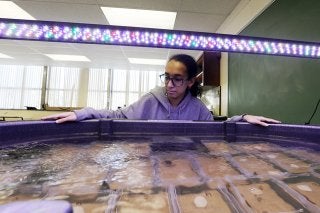
In a lab where streams run indoors and ecosystems are built by hand, Emily Gonzalez is doing more than collecting data. She’s helping answer questions that could shape the future of Pennsylvania’s waterways — and directly support large-scale restoration efforts already underway in the West Branch of the Susquehanna River.
Gonzalez, a biomedical sciences major at Commonwealth University-Lock Haven, has spent up to four days a week in a wet lab this spring, carefully tracking dissolved oxygen, conductivity, temperature, and pH. Her project focuses on a deceptively simple question.
What happens when native freshwater mussels share space with invasive species?
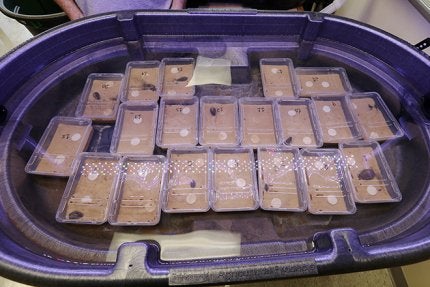
The answer could have real consequences for conservation strategies tied to regional initiatives like the West Branch Susquehanna River mussel restoration project, where rebuilding native populations is a critical goal. Working under Daniel Spooner, associate professor of biology, Gonzalez is studying the ecological role of native Elliptio mussels compared to invasive Asian clams (Corbicula fluminea).
Native mussels act as natural filters, improving water quality and stabilizing ecosystems — a function central to ongoing restoration work in the Susquehanna watershed. But invasive species can disrupt those benefits in ways scientists are still working to understand, potentially complicating efforts to reestablish healthy mussel populations in the river.
“The one that Emily is doing is looking at the functional benefit in the ecosystem of native mussels,” Spooner said. “We’re trying to see whether having the native mussels in there makes a difference in terms of the function.”
The research takes place in mesocosms — controlled, intermediate-scale stream systems that bridge the gap between lab precision and real-world complexity. That balance allows researchers to generate insights that can inform fieldwork happening at sites like the West Branch, where scientists and partners are actively reintroducing and monitoring mussel populations.
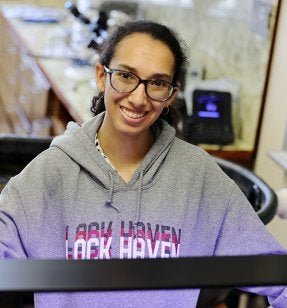
“At the fine scale, some people do experiments in five-gallon tanks, where there’s not a lot of realism,” Spooner said. “These make a nice intermediate scale … where we can ask meaningful ecological questions.”
For Gonzalez, that scale makes the science feel tangible.
“Honestly, I love seeing how the mussels are affecting the mesocosm,” Gonzalez said. “At first, nothing really changed. But the longer the mussels are in the mesocosm, the more growth you can see building up. All that growth is what we're collecting at the end of the experiment and measuring as a part of our final results.”
That growth — biofilm and organic material — is a key indicator of ecosystem health and one of the central measurements, she says. It’s also the kind of data that can help researchers better understand how restored mussel populations might improve water quality in real river systems.
Short term, Gonzalez and Spooner hope to better understand how these species interact. Long term, the goal is more ambitious — developing a protocol to remove invasive clams without harming native mussels, a challenge directly tied to the success of restoration efforts in the Susquehanna River.
“It’s crazy to think that what I’m doing has the potential to change our understanding,” Gonzalez said. “My mesocosm may seem small, but the data I’m collecting could have huge ramifications.”
"I like knowing my research might make a difference or help someone else make a difference. Because I think that's a huge part of science we don't think about often — how others inspire us to keep pushing forward. And if that alone doesn't boost your confidence, then I don't know what will!"