Student research advances understanding of water quality in mining-impacted regions
Mansfield
Posted
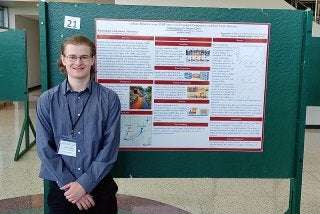
BINGHAMTON, N.Y. — Caiden Henley, a senior forensic chemistry major at Commonwealth University–Mansfield, recently presented original research at the 8th Annual Binghamton University Conference in Undergraduate and Graduate Chemistry Research, highlighting new insights into the environmental behavior of lithium in acid mine drainage (AMD) systems.
Henley’s poster, “Lithium Behavior in an AMD-Impacted Watershed: Comparison with Rare Earth Elements,” examined how lithium and rare earth elements (REEs) move through an AMD-impacted watershed. The research demonstrated that while lithium and rare earth elements are transported through the system via similar mechanisms, their ultimate environmental fates diverge due to differences in their chemical properties.
"Basically, we're looking at how different elements transport through polluted streams caused by acid mine drainage," Henley said. "We focused on lithium and rare earth elements and found they behave differently in the water systems we observed."
He added, "We found that rare earth element concentrations are affected by the acidity of the water. As the acidity returns to normal levels, iron precipitates out of solution, which can cause rare earth elements to co-precipitate with the iron or adsorption onto iron already removed from the water. On the other hand, the reduction in the lithium concentration is caused by dilution, meaning it acts more conservatively in these systems."
Henley conducted his research under the guidance of faculty mentor Gregory Carson, associate professor of physical and environmental sciences at Mansfield. The project contributes to a growing body of knowledge aimed at improving the understanding of watershed chemistry and environmental remediation strategies.
"What initially sparked my interest in this topic was the increasing necessity of these elements for things like batteries and electronics," Henley said. "AMD systems allow us to look at the extremes of their effects on the environment. So overall, it was a good mix of chemistry and something that has real impacts on the environment."
The Binghamton University conference, now in its eighth year, provides a platform for undergraduate and graduate students to share research findings, engage with peers and faculty, and gain professional presentation experience. Participation in the event reflects Henley’s commitment to academic excellence and hands-on scientific inquiry.
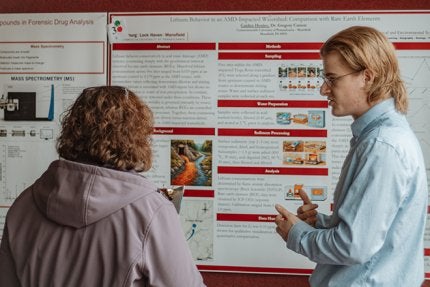
Henley, currently applying to various lab positions to gain more lab experience after graduation, said his research will help us understand how pollution moves and where these elements observed end up.
"This is important for a couple of reasons," Henley said. "First, it’s important for cleaning up contaminated sites with a heavy concentration of these elements, but also, it’s important for recovering valuable elements that are becoming more sparce."
Henley’s work underscores the importance of undergraduate research opportunities in preparing students for careers in science, environmental analysis, and forensic chemistry. By exploring the behavior of elements in environmentally impacted systems, the research also supports broader efforts to monitor and manage water quality in regions affected by legacy mining activity.