Unlocking Opportunity
Lock Haven
Posted
A desire to help others set James Richtscheit on the path to nursing. Hands-on learning is helping him turn that purpose into a profession.

James Richtscheit’s path toward nursing has rarely involved just one commitment at a time.
There have been college classes and evening certification courses. Shifts in a family practice clinic and a summer nursing externship. Military obligations, and now, work in an emergency department.
Each experience has opened a door to the next, bringing the Commonwealth University-Lock Haven nursing student closer to graduation with something beyond coursework behind him — a growing understanding of patients, professional relationships and a clearer picture of the nurse he wants to become.
“I’m always looking for my next opportunity,” Richtscheit says.
His direction wasn’t always so clear. He entered college as a business major before moving into health sciences, initially considering a physician assistant career. Nursing eventually emerged as the right fit for his desire to work directly with people.
An experience outside the classroom helped bring that motivation into focus. Working as a corrections officer in Clinton County during his early college years, Richtscheit helped an injured incarcerated man get to medical care. The encounter reinforced something he was discovering about himself.
“I wanted to take care of people and make a difference,” Richtscheit says. “There’s multiple different ways in college that you can make a difference on people, but I wanted to directly help people.”
Wanting to enter health care and knowing what that work feels like, however, are different things. Richtscheit wanted to close that gap.
Through Commonwealth University’s Workforce Development, he pursued certified clinical medical assistant training, adding evening and occasional weekend classwork to his college schedule. While his academic courses covered anatomy, chemistry and biology, the certification program introduced practical responsibilities such as giving vaccinations, checking in patients, and preparing them to see a provider.
“I really wanted experience in the health care field, because I had no experience in the health care field prior to that,” Richtscheit says. “That really kick-started my journey that I’m on now and led me to all the other stuff I’ve been able to get to.”
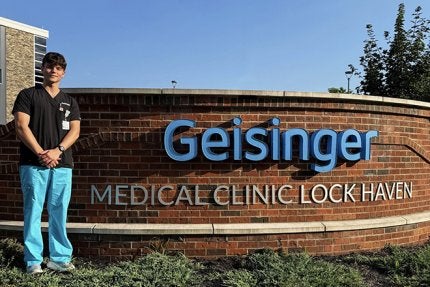
Balancing the additional coursework with military obligations required flexibility. He credits instructors who understood those demands and helped him navigate the schedule. The investment led to a medical assistant position with the Geisinger clinic in Lock Haven, where he worked in family practice two or three days a week during school and full time over the summer.
Suddenly, classroom concepts had faces attached to them.
“Whenever you’re just hitting the books all the time, you’re learning this stuff, but you’re not really using it,” Richtscheit says. “Being able to see how that can be used hands-on was a really great experience.”
Just as important, he was learning to talk with patients — to become comfortable asking questions, listening, and helping people prepare for care.
“You got to get comfortable with talking to them,” Richtscheit says. “Because if you can’t talk to them, you’re not going to be able to figure out what’s wrong with them.”
As his confidence with patients grew, so did his awareness of where that first health care job could lead.
His clinic manager told him about Geisinger’s nursing externship, an opportunity to learn alongside nurses while earning a paycheck. Richtscheit pursued it, spending a summer gaining exposure to the emergency department, intensive care unit, operating room, and other settings.
He encountered patients with different needs and levels of illness, observed nursing responsibilities and learned more about procedures involving IVs and blood transfusions.
“I wanted to get more knowledge going into my senior year here so that I could really relate it,” Richtscheit says. “Because reading about it in the book and then seeing it hands-on, it just helps.”
The experience also helped him distinguish between what interested him and where he hoped to build a career. The emergency department appealed to him because of its variety. The operating room offered a compelling look at how the body works and deepened his interest in becoming a nurse anesthetist.
Richtscheit says the immediate goal is intensive care, working with seriously ill patients who need close monitoring. For all the technical exposure, though, he places particular value on the human side.
“Really, just the interaction with patients is probably the most valuable thing that somebody could have,” Richtscheit says.
The externship brought another step forward, a student nursing assistant position in the emergency department at Jersey Shore Hospital, where he plans to work through graduation.
“Yes, it kind of all built on itself,” Richtscheit says.
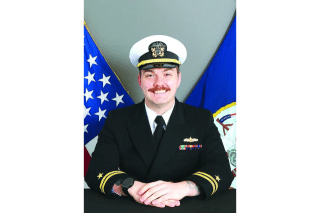
Those experiences now complement his studies in Lock Haven’s associate-degree nursing program and bachelor’s-level nursing courses through Bloomsburg. His preparation extends beyond health care settings, too. Time in ROTC helped develop his leadership skills and sparked an interest in military service. He subsequently joined the Pennsylvania National Guard, with formal combat medic training still ahead.
Managing those commitments requires choices. Some things must take a back seat, he acknowledges, but opportunities that advance his career remain a priority.
“To me, I just think it’s worth it,” Richtscheit says.
That outlook gives graduation a different meaning. Rather than an end to his preparation, it will mark another step in a process he expects to continue throughout his career.
“A part of health care is that you’re never done learning,” Richtscheit says. “Even whenever I graduate, and I’m working, I’m still going to be learning stuff every day.”