A Journey Toward Purpose
University-wide
Posted
Commonwealth University’s growing community engagement tradition helps students see themselves as leaders, advocates, and sources of encouragement.
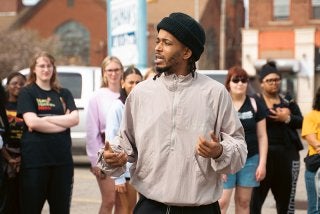
PITTSBURGH — In Homewood, the lesson was bigger than a panel discussion.
It began with Commonwealth University students arriving in Pittsburgh this spring not as visitors but as participants in a living classroom — one where policy, education, and contact were legs of a stool supporting real people, real neighborhoods, and real change.
The university’s bi-annual Out of the Classroom: Into the Community Program trip has become one of those unique experiences in higher education that feels both deeply practical and deeply human, rooted in service, identity, and belonging.
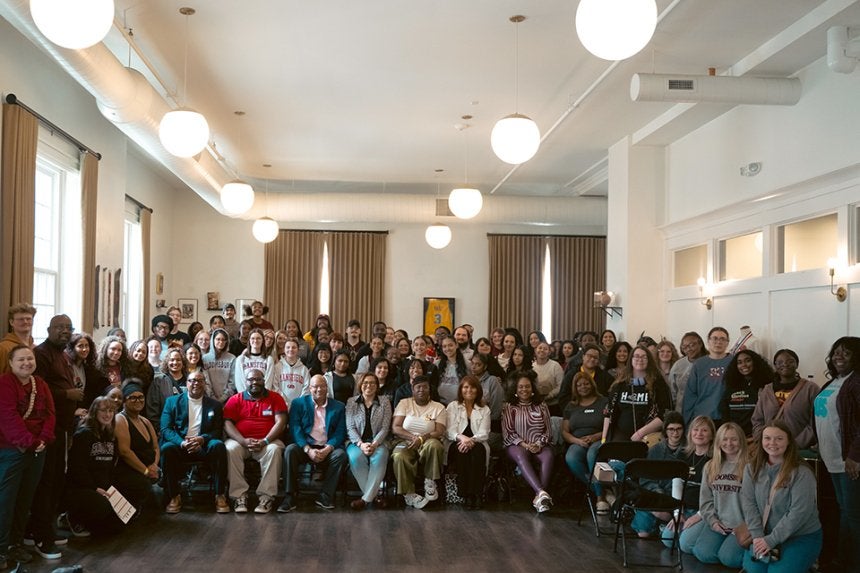
Ralph Godbolt, executive director of Access and Engagement and Act 101, said the community engagement program began in 2018 with just four students. This spring, it brought close to 80 students from the Bloomsburg, Lock Haven, and Mansfield campuses to Pittsburgh’s Homewood neighborhood. It's the largest group yet.
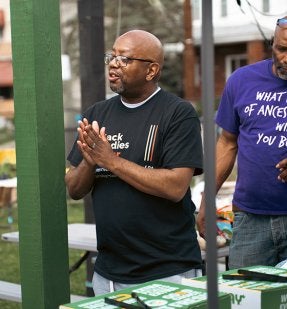
“Ultimately, this has been the goal,” said Godbolt, a goal he adds as much about retention as it is about revelation. “What the research tells us is that students who are able to volunteer, definitely in communities similar to ones they may come from, are able to make that connection."
He added, "They’re more likely to be retained, because they’re able to see themselves as role models.”
For Godbolt, the trip is also about visibility. The kind that changes how young people see themselves and how college students see their responsibility.
“You cannot be what you cannot see,” said Godbolt, repeating a phrase that's become a guiding principle of the experience. “To see 80 people walking around your neighborhood, 70% who look like you, makes a difference.”
A classroom with purpose
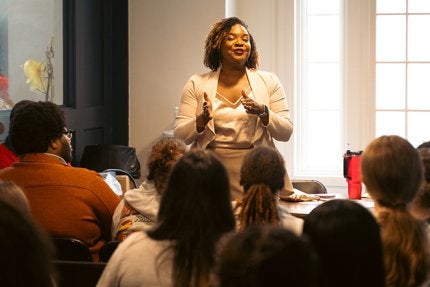
This year’s trip leaned into Kerrie DeVries’s “three-legged stool” model that she teaches, a framework that asks how policy, education, and contact can create lasting change in anti-Black racism in the United States. A panel discussion held for the students was designed to make that model tangible, and the lineup brought together people whose careers have been shaped by that work from different directions.
The panel included Rochelle Jackson, founder and CEO of the Black Women’s Policy Center; former Pittsburgh Mayor Ed Gainey; Felicity A. Williams, executive director of the Pennsylvania Policy Center; Cynthia Haines, president and CEO of HEAR Foundation; Ciora Thomas, founder and executive director of SisTers PGH; Dr. Christine McClure of the University of Pittsburgh; and Brenna Crable, educator and board leader.
Godbolt said the programming was intentionally tied to what many students had already studied.
“About 70% definitely of the Bloomsburg students, at one point or another, have enrolled in our Anti-racism class (offered through the Black Studies Minor),” Godbolt said. “One of the key lessons (DeVries) teaches is something called the three-legged stool. So for students to be able to say, ‘I literally learned about this and now have made that connection here on this trip,’ that’s what makes it so cool.”
That connection mattered because the lessons were not presented as theory alone. They were presented as lived experience — policy shaped by advocacy, education shaped by access, contact shaped by community care. The result was a day that asked students not simply to listen but to recognize themselves in the work.
Students finding themselves
For students, that recognition came in unexpected moments.
Ariya Hansen, a criminal justice major at Commonwealth University-Bloomsburg, said what stayed with her most was the way Homewood modeled community in action.
“It felt so good to be able to work together with a community who shares the same beliefs and wants for the community,” Hansen said. “Everyone was so kind to one another that I assumed they all knew each other, but they're simply just good neighbors.”
Her reflection returned again and again to the phrase that framed the trip.
“You can’t be what you can’t see,” Hansen said. "This hit me deeply and completely altered the way I view opportunities for both me and the people of Pittsburgh, as well as any other community.”
She also described the trip as personally clarifying. She says the trip was not only an act of service, but a confirmation that community work is the path she wants to keep following.
“This experience will forever have an impact on me,” Hansen said. “I want to help the underprivileged, disadvantaged, impoverished, needy, and the poor.”
Ibrahim Sheriff, a nursing major at Commonwealth University-Mansfield, said the experience helped him understand leadership in more grounded terms.
“Leadership isn’t just about holding a position," Sheriff said. "It’s about action, connection, and consistency. Being in Pittsburgh showed me how important it is to engage directly with communities, understand their needs, and advocate for change in meaningful ways.”
He also felt the power of bringing students from three campuses together.
“At times, it feels like Mansfield operates separately from Lock Haven and Bloomsburg,” Sheriff said. “So it was refreshing to come together and truly feel like one united Commonwealth University.”
The power of contact
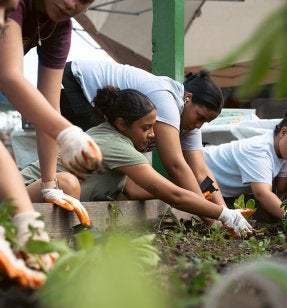
The weekend made room for more than speeches and structured learning. Students walked through Homewood, visited community spaces, and encountered the kind of spontaneous moments that can’t be planned on an itinerary. Godbolt recalled one scene from the neighborhood park.
“There was a teenager with what I now know are his two nephews,” Godbolt said. “They start to follow us step by step. And then now our college students start to interact.”

That, too, was part of the lesson, he says.
“It’s that sense of, ‘man, I’m really making a difference here. I’m really giving back,’” Godbolt said. “I hear a lot from the students say I feel like I’m really making a difference.”
The trip is focused on the Homewood neighborhood of Pittsburgh, Godbolt’s hometown. That origin still matters to him.
“I would not be where I’m at if people didn’t commit themselves to young people in Homewood,” Godbolt said. “When we started this, it was like, 'hey, I want to get back to where I came from.'”
That sense of return gave the trip an emotional center. It was not charity from a distance. It was an intergenerational loop of investment, one that asked today’s college students to imagine themselves as tomorrow’s mentors, advocates, and builders.
What grows from here
The program’s growth suggests the model is working. Godbolt said Commonwealth University plans to expand partnerships across campuses, strengthen intentional work with high school students, and add more one-day service projects in local communities. A three-campus project in Williamsport is planned for the fall.
He sees the program as one part of a larger support structure.
“You have the Emerging Scholars, which is the academic support piece," Godbolt said. "You have the Basic Needs Shoppe, which is delivering resources and security. You have a new program (Mansfield Leadership Academy) that’s providing leadership skills. This community service piece is just one piece of this large puzzle geared towards increasing retention rates.”
For the students who made the trip, the puzzle came together in the streets of Homewood — in the conversations, the panel, the walking tour, the shared meals, and the sight of young people encountering college students who looked like them. The experience, as Hansen put it, was “a beautiful experience,” one that deepened her desire to do good.