From Clemson Clinics to Friday Night Lights
Lock Haven
Posted
Commonwealth University-Lock Haven 3+2 athletic training grad serves hometown high school
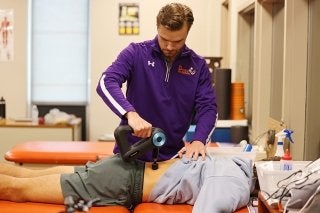
As a teenager, Sam Betz used to walk the halls of Danville Area High School into its athletic training room as a curious co-op student. Now he walks in as one of the school’s two certified athletic trainers, responsible for the health and safety of hundreds of student-athletes.
“Every day is different. You never know what’s going to come through the door,” said Betz ’23/25M, a Danville native and Commonwealth University–Lock Haven alumnus. “As a high school athletic trainer, you cover pretty much everything.”
Betz’s responsibilities include injury evaluation and management, game and practice coverage, and handling parts of the registration process, such as tracking physicals. On any given day, the training room fills with athletes from nearly every sport the school offers.
“I really wanted to come back to Danville,” said Betz, who completed Lock Haven’s accelerated three-plus-two athletic training program, finishing his undergraduate work in three years and advancing straight into the two-year graduate program. “This is home, and it’s pretty special to be working with the same person I did my co-op with.”
Discovering Athletic Training
Betz’s interest in athletic training started in the same place he now works, spending afternoons as a co-op high school student in the training room with John Zayas ’12/13M, the athletic trainer and Bloomsburg alumnus who’s now his colleague.
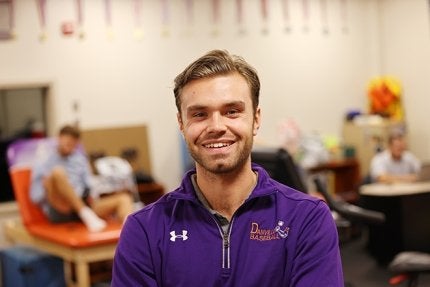
“I got to see what the job really looks like day to day,” Betz said. “I saw how much care goes into it with building relationships with athletes, coaches, and the whole community.”
What impressed him most was watching injured athletes move through the entire process.
“Treating someone, helping them through rehab, and then seeing them come back to the sport they love,” Betz said. “That really stuck with me.”
Majoring in Athletic Training
When it came time to pick a college, Betz toured several schools but kept coming back to Lock Haven. The campus, the town, and especially the athletic training faculty made the decision easy.
“I really liked the professors I met and the curriculum they had,” Betz said. “Lock Haven is a beautiful town, and the sports culture there is strong. Working with all the different teams was great.”
As an undergraduate, Betz took courses in anatomy, physiology, exercise physiology and sports psychology, among others. Those classes, he said, laid the groundwork for graduate study.
“I really enjoyed learning about the body, especially in lab,” Betz said. “Getting that foundational understanding was huge for going into the master’s program.”
Advancing in Athletic Training
In graduate school, Betz said the focus shifted to higher-level skills. Courses in evaluation techniques and functional anatomy were particularly meaningful. Betz points to the cadaver lab as a pivotal experience.
“Being able to see a real human body — muscles, tendons, ligaments, nerves, blood vessels — that’s pretty much everything you’d want to see,” he said. “It made the anatomy we learned in undergrad come to life.”
Betz credits his evaluation techniques courses with shaping him as a clinician.
“Evaluation and assessment are one of the big domains of athletic training,” he said. “Those classes were probably my favorite, because that’s where you really learn how to assess the body.”
Clinical Rotations
Clinical experiences started close to campus. Betz’s first rotation was at Lock Haven, where he worked with football, volleyball, track and field. His second rotation took him to Lycoming College in Williamsport, where he focused primarily on men’s lacrosse, with some time with wrestling and women’s lacrosse.
A third rotation exposed him to multiple settings in quick succession. He spent time at Bald Eagle High School, rode along with an EMS crew, and observed at a chiropractor’s office that emphasized sports patients. He also participated in an industrial athletic training day at the Frito-Lay facility in Williamsport.
“In the industrial setting, you’re working with people in factories, doing a lot of ergonomics and injury prevention,” Betz said. “It’s a different world, but it’s good to know those options exist. Amazon and other companies hire athletic trainers for those roles.”
High-Level Immersion at Clemson
The capstone of Betz’s clinical training was his immersion experience — a full-semester internship that serves as the fourth and final clinical rotation in the graduate program. Betz headed south to Clemson University and joined the track and field sports medicine staff for five months. The internship sharpened skills in three key areas, he said.
“First was rehab,” Betz said. “Really understanding how to program rehab. My preceptor (internship mentor) emphasized how important that is.”
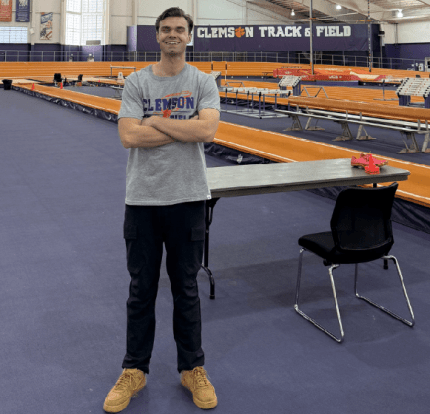
Second was preparation.
“I didn’t travel much with the team, but I helped pack before trips,” Betz said. “You make sure you have everything — rehab equipment, electrical stimulation units, medications, foam rollers, cupping sets. You may not need all of it, but if you do, it has to be there.”
The third lesson was about balance.
“Athletic training is a serious job, because you’re responsible for people’s health,” Betz said. “You need to build relationships, ask athletes how school is going, what their goals are. Crack a joke once in a while. That makes a difference for them.”
High-impact Experiences
Across his clinical rotations, Betz saw athletes from a wide range of sports and levels. That variety, he said, is essential for athletic training students.
“Different sports come with different injury patterns,” he said. “In swimming and baseball, you see a lot of upper extremity injuries like shoulders and elbows. In track and cross country, you see a lot of lower extremity injuries. Football adds more acute injuries like ankle sprains and contusions.”
Prepared for the Profession
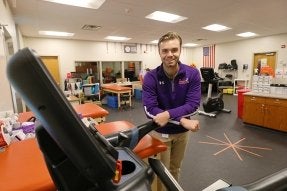
Looking back, Betz says Lock Haven’s athletic training program gave him both the technical skills and the confidence he needed.
“The professors were really supportive in the classroom, with clinical placements, and with helping you figure out your goals,” Betz said. “The curriculum prepared me to pass the board exam and to do my job day to day.”
That preparation shows up every time an athlete walks in with a new injury.
“There are moments where I’m doing an evaluation and I can remember sitting in class learning the exact technique,” Betz said. “It’s a good feeling to know that what you learned translates directly to helping someone in front of you.”