Driven by Discovery: A journey through the pre-med pipeline
Bloomsburg
Posted
Guided by mentors and powered by curiosity, this Commonwealth University-Bloomsburg pre-med major transformed scientific challenge into personal conviction.
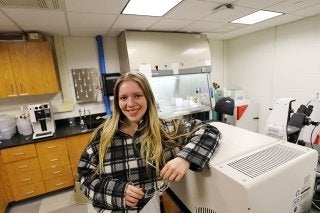
Lauren Boyer has always known she wanted to help people. Growing up in Bloomsburg with her mom working in the medical field, she saw firsthand how science can change lives — and she wanted in.
Today, the newly minted Commonwealth University–Bloomsburg chemistry pre-med graduate is leaving campus with two years of cancer research behind her, a national molecular biology and biochemistry accreditation on her resume, and a clear sense she’s ready for medical school and the adult world that comes with it.
Finding her pre-med path
When Boyer arrived on Bloomsburg's campus, she knew she was drawn to medicine but wasn’t yet sure how it would translate into a major. Chemistry wasn’t a foregone conclusion. It was a risk she took after discovering how much she enjoyed being challenged in her science courses.
“I was really challenged in the sciences,” Boyer said. “I didn’t understand it at first, and I really loved the challenge.”
Organic chemistry became a turning point.
“Organic chemistry is tough for everybody,” Boyer said. “I didn’t do well at first, and then I pulled myself up. It really put the idea in my mind that I could actually do this.”
At the same time, she found herself drawn to biochemistry’s human focus — DNA, receptors, and the molecular machinery that keeps us alive. Those courses helped her connect lectures and labs to real people and real diseases, deepening her conviction that she wanted to become a doctor.
CU’s pre-medical sciences studies certificate is designed exactly for students like Boyer. It layers rigorous biology, chemistry, physics, and seminar courses on top of a selected major, creating a structured path toward professional school preparation. For Boyer, that meant a chemistry major with a pre-med focus that still let her lean into biochemistry whenever she could.
From classroom to cancer lab
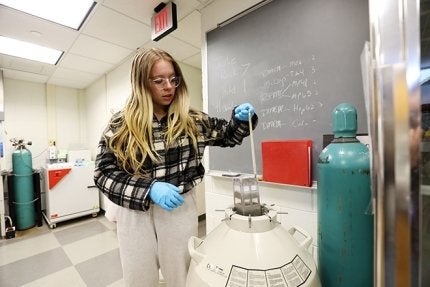
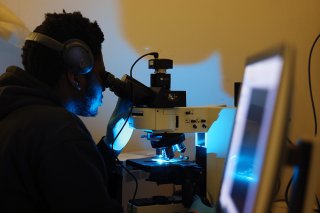
By sophomore year, Boyer wanted to translate her growing love of biochemistry into real, hands-on research. She began visiting labs across the chemistry department until she found a project that focused on melanoma, an aggressive form of skin cancer with limited curative options.
“I was looking for a research opportunity,” Boyer said. “I wanted to work with something that I was interested in, and I wanted to do it in the biochemistry field,”
She joined a small team with Michael Borland, professor of biochemistry, working with long-frozen cancer cell lines stored in liquid nitrogen. The lab studies berberine, a natural compound found in plants and present in turmeric, that has demonstrated anti-cancer potential in melanoma and other tumor types.
“We’re using a natural treatment,” Boyer said. “We’re using that to treat the cancer cell lines through a specific pathway.”
Their experiments track how certain genes and receptors respond, using cell counting and three-dimensional spheroid models to actually visualize tumor growth and regression.
“We basically know the pathway that it’s mediating and see whether it’s a viable treatment for that pathway to decrease cancer or even kill it,” said Boyer, adding that working on a project that parallels the kind of studies done in professional cancer research labs has reinforced her belief that evidence-based natural treatments can play a powerful role in future therapies.
Achieving national recognition
Though she calls herself a chemistry major, Boyer’s transcript reads like a roadmap through both chemistry and biology. When Borland suggested she sit for a national molecular biology and biochemistry accreditation exam through the American Society for Biochemistry and Molecular Biology (ASBMB), she hesitated.
The ASBMB certification exam is a one-hour, 12-question, free-response assessment designed to test students on core concepts such as energy and metabolism, macromolecular structure and function, information storage and transfer, and experimental skills.
To prepare, she spent two to three months reviewing while taking molecular biology and biochemistry courses, effectively turning her semester into a full-immersion study plan.
“Just even learning (the topics) and preparing for the exam has helped me go through and take the MCAT and proceed my career,” Boyer said. “It shows you that, you know, we might not just be chemistry students. We can also do molecular biology and biochemistry.”
That credential, she adds, “rounds my personality, and it definitely gives me the confidence I need. I don’t have to just do chemistry. I can do anything.”
Power of small classes and personal mentoring
Boyer is quick to point out she didn’t get here alone. Bloomsburg’s chemistry program emphasizes small classes, hands-on labs, and direct mentoring by faculty with advanced degrees. Chemistry majors on the pre-medical sciences path also receive targeted advising from a dedicated pre-medical sciences advisor who knows the professional-school landscape in detail.
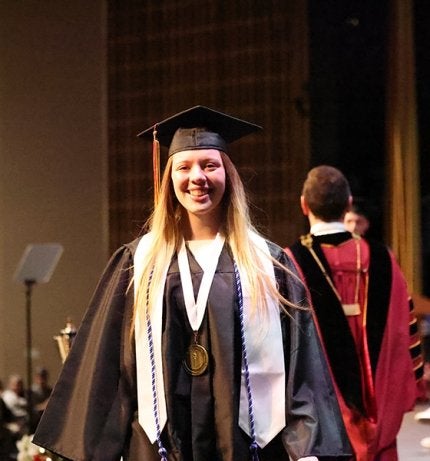
For Boyer, that’s meant professors who not only teach but walk with her through every milestone.
“The faculty has been really, really great in helping me apply,” Boyer said. “Dr. Borland opened my MCAT results for me, so you know he’s been with me through the whole process. So have a lot of the faculty.”
She believes the chemistry program’s scale is one of its greatest strengths.
“Our class sizes are like, max 50, whereas other schools, they have a big class size,” Boyer said “I get the one-on-one experience, and I can go ask questions. I get the help I need.”
That access has been crucial in navigating a med-school application process she describes as “very daunting” and “very overwhelming.” General checklists exist, but, as she points out, “they’re not personalized to you and the different requirements you need to make it further or succeed.”
Having professors who know her well means they can help her tailor decisions — from course loads to exam timing — to her individual goals.
“I have loved the last four years, I truly have,” Boyer said. “I’ve met a lot of great people, and a lot of great people have helped me. It’s just changed who I am. I feel ten times better leaving here than I did coming here.”