Piecing It Together: Finding a path from pharmacy to pathology
Bloomsburg
Posted
A love for science and a campus full of open doors helped this Commonwealth University-Bloomsburg pre-med major connect molecules to medicine and find his professional purpose.
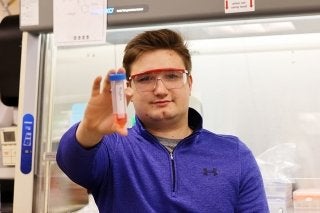
On paper, Andrew Faust’s story looks like a straight line. Chemistry pre‑med major to standout researcher to national exam taker to multiple medical school acceptances.
In reality, it’s a trail of small decisions. A conversation with a guidance counselor, a family pharmacy, a professor’s open office door — that turned a curious high school student into a future pathologist schooled at Commonwealth University–Bloomsburg.
Growing up pharmacy
Long before Faust declared a college major, medicine was already part of his daily life.
“I was exposed pretty early to pharmacy,” Faust said. “I’ve seen kind of the struggles with pharmacy, and I also knew I wanted to do more than just the medicine part. I wanted to go more clinically and see the behind‑the‑scenes stuff … not just what the medicines were, but why these patients got these medicines.”
That question — “Why this patient, this drug, this outcome?” — eventually steered him toward a specialty many students don’t encounter until later. Pathology.
“It’s my number one choice,” Faust said. “I think it’s so cool how you can look at just a group of cells and paint this whole story of what the diagnosis is.”
Faust says pathologists are “kind of like an all‑around doctor, because you get bits and pieces from each specialty. You’re following this one patient, and then you get the histology, and then you kind of pull that all together — what the microscope is telling you, and then what all the other clinician notes say.”
Faust's interest in taking that diagnostic work into toxicology connected him with one of the most defining experiences of his undergraduate career.
“As I met with my advisor (Dr. Toni Bell), she recommended me to (Dr. Michael Borland),” Faust said. “It’s been honestly game‑changing for me. I’ve done so much and learned a lot through him. Then took biochemistry with him … two of my favorite classes.”
Melanoma research with real‑world connections
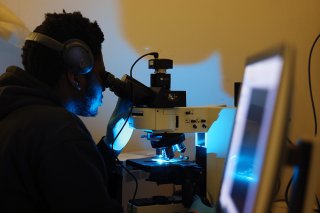
Working with Borland in the toxicology lab, Faust spends his time on the molecular frontlines of melanoma, one of the deadliest forms of skin cancer. The team studies cancer cell lines and the pathways that drive growth or trigger cell death.
What excites him is the connection to future patient care.
“It’s kind of neat to see how all this kind of wraps into being applied to medicine,” Faust said. “We’re at the finer details of what could be potentially … maybe way, way down the line, a treatment that would be applied clinically. I’m seeing all these tiny little details in the science behind all this. The framework behind it.”
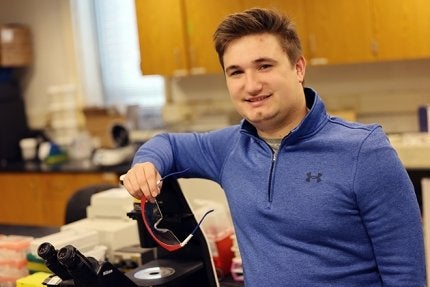
Two years in the lab have also given him a head start in his classes.
“A lot of the things I’ve learned in here, I’ve used in other classes and labs,” Faust said. “It’s kind of nice, because I’ve already beat that learning curve.”
The work even follows him home. At his family’s pharmacy, a customer once asked for turmeric supplements.
“I didn’t even realize we sold turmeric,” said Faust, adding a pharmacist wondered why anyone would want it. “I was like, I actually know this, because I do research on the thing that’s derived from turmeric that’s anti‑inflammatory.”
“It’s a very niche moment, but it was kind of neat to be like, ‘Hey, I know that from the lab that I work in.’”
Big time confidence boost
As he piled up biochemistry and molecular biology courses, Borland urged Faust to sit for a national accreditation exam that would put his knowledge to the test.
“He told me about how of all the schools across the nation, it would show you where you stand,” Faust said. “I thought it was really neat. It gave me confidence when I got that score back that I know my stuff, and I was taught well here.”
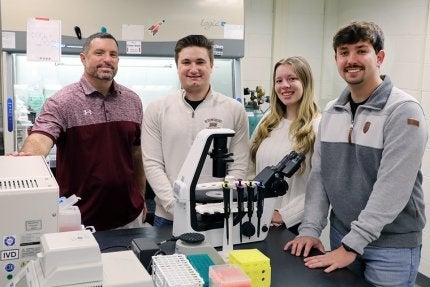
And that begins and ends with the professors, according to Faust.
“One of the biggest things I always tell my friends is one of the best things here is the insane amount of support we get from the faculty,” Faust said. “Dr. Borland, especially for me, I’m awfully close with him. I can just walk into his office, and he’s there for pretty much anything, whether it’s school-related, outside of school-related, lab-related.”
He contrasts that with friends at larger universities who mainly interact with changing rotations of teaching assistants.
“It’s one of those things I like to flex with my friends … that I have this unique opportunity,” said Faust, highlighting that individualized faculty guidance has helped shape everything from his course choices to his personal statement for medical school. “I got my first acceptance way back in July for Duquesne College of Osteopathic Medicine, and then I was accepted to West Virginia and PCOM.”
Faust will attend Philadelphia College of Osteopathic Medicine (PCOM) in the fall.
From a kid stocking shelves in his dad’s pharmacy to a future pathologist reading diagnoses in cells, Faust has used Bloomsburg’s chemistry pre‑med program to assemble his own puzzle, and the picture coming into focus looks a lot like the physician he set out to become.
“It’s been crazy, but it’s super exciting.”