From Bloomsburg to Neuroscience at the Cleveland Clinic
Bloomsburg
Posted
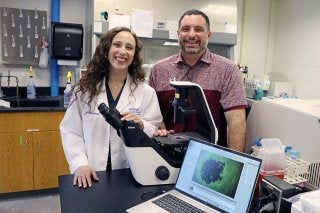
Eight years ago, Julie Marchioni’s plan was to study nursing and swim in college. This July, the 2018 Bloomsburg biochemistry graduate begins her medical residency in neurology at the Cleveland Clinic, one of the top ten neurological hospitals in the U.S.
A May graduate of the Medical Doctor program at Geisinger College of Health Sciences, Marchioni built the foundation for her medical career in the chemistry labs of Hartline Science Center and the pool of Nelson Field House.
“When I was looking at colleges, I wanted to be a nursing major and I knew Bloom had a good program. I also wanted to swim. We didn’t want to pay extra for a degree I could get at a state school,” says Marchioni, a native of Reynoldsville in western Pennsylvania. “It was between here and Clarion, but I met with Coach Stu Marvin, and he won me over. So, I was eastbound.”
“When I started at Bloom, I took Chem 101 and loved it. Later, in the spring, I took Chem 108 — the organic/biochemistry nursing course,” recalls Marchioni. Professor Michael Pugh (now retired) pulled her aside and told her, “‘The way you perform on these exams, that's someone who should be a biochemist.’ He introduced me to a student named Kim Hollister who had made the same switch, who said, ‘If you want to know why things happen, think about biochemistry.’ That resonated perfectly. I reached out to Dr. Michael Borland, who took me under his wing, and I never looked back.”
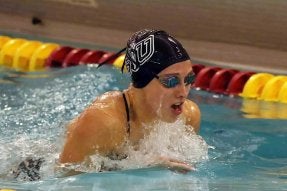
While at Bloomsburg, Marchioni was also a member of the women’s swimming team, specializing in the butterfly and serving as the team captain. “My event was the butterfly. It’s the one people tend not to like, but it was my baby. When I went to college, it was kind of like, ‘I have to swim; this has been who I am.’”
“Being a student-athlete in a demanding major isn’t just about physical training; it’s about time management. It taught me dedication. If my grades weren’t up, I couldn't go to practice. It taught me to be efficient, manage my time well, and stay physically fit,” adds Marchioni. “That’s a muscle I use now. My teammates and I would be in the library until it closed, then get up for practice in the morning and do it all again. Even though we think of swimming as an individual sport, it taught me how to be a team player. At the end of the day, my race matters because the win or loss is determined by everybody.”
“Julie is proof that the approach at Bloomsburg—hands-on, research-oriented, and instrumentation-integrated—provides the foundation and opportunities to students that become a springboard to big career success,” says Michael Borland, professor of chemistry.
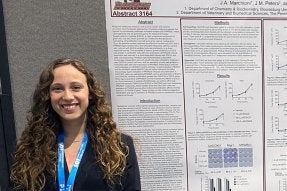
While at Bloomsburg, Marchioni earned Proficiency on the national ASBMB Accreditation exam — an opportunity she had because Commonwealth-Bloomsburg is one of only 120 universities nationally (and one of only two Pennsylvania State System universities) to earn accreditation. She also did melanoma research in Borland’s lab and presented at a Society of Toxicology conference in San Diego.
“Julie thrived in an environment where she could build her systems thinking and apply it to real-world science and medical scenarios,” says Borland.
Biochemistry provided a particularly good foundation for Marchioni’s specialization in neurology. “I love systems. Biochemistry taught me how things interact and how you can't just memorize everything — you have to understand how the components interplay,” she says. “When I started medical school, I was told I wouldn't see much biochemistry, which discouraged me.”
“Neurology was the last thing we did in our preclinical curriculum, and it's known for being challenging. But as I learned it, I saw how biochemistry — neurotransmitters and receptors — came into play,” says Marchioni. “Neurology is a system. When something goes wrong, we have to localize where and why. It’s a deep understanding of everything. It felt like everything I loved in science culminated with getting to work with people.”
Looking toward the future, Marchioni is eager to work at the cutting edge of the field, where advancements in deep brain stimulation for Parkinson’s and new infusions for Alzheimer’s are changing lives.
“The field is growing and changing. We have infusion medications for Alzheimer’s that can slow the progression if caught early. We also have new techniques in deep brain stimulation for Parkinson's disease.”