Lighting the Way
Bloomsburg
Posted
Reading scripts, sketching thumbnails, and balancing color theory with technical limits, Theo Lemons '27 shows how Bloomsburg’s small, hands-on program prepares student designers for the national stage.
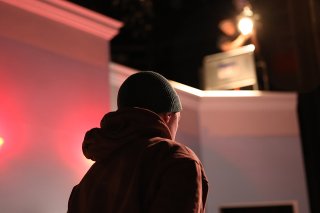
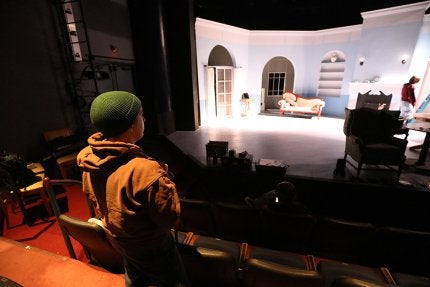
Silence settles over an empty theatre stage, but it won’t last for long.
In a few days, the empty space will be transformed. Lights will be hung, focused and programmed. Colors will shift. Shadows will deepen. Actors will emerge from darkness, draw the audience’s attention and disappear again as the story moves forward.
For Theo Lemons, the transformation is where the magic happens.
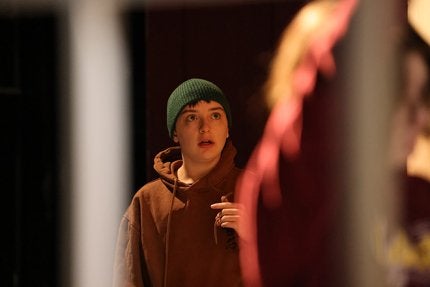
The junior Commonwealth University-Bloomsburg theatre arts major has found a creative home in lighting design, which combines visual art, technology, collaboration, and storytelling. It’s also a field Lemons discovered almost by accident, after years of participating in band, choir and theatre during middle school and high school.
“I was just generally artsy,” Lemons says. “I knew I was interested in something that maybe kind of combined arts and technology in a way.”
Theatre offered that combination. Lemons enjoyed working on stage crews and behind-the-scenes production, while also considering fields such as graphic design and music technology. Ultimately, the possibility of contributing to live entertainment proved especially compelling.
“I wanted to stay in the live entertainment world in some degree,” Lemons says. “So that’s kind of why I picked that career.”
At Bloomsburg, that career direction has continued to come into focus thanks to the theatre arts program’s opportunity for Lemons to pursue a specialized interest.
“I saw that they had a theater technology concentration I could go into specifically,” Lemons says. “That wasn’t just a plain theater bachelor of arts, which was something I was looking for.”
Discovering the design
In high school, Lemons worked with sets and props, but the technical resources were limited. The experience of programming and operating the lighting system opened the door to a new form of creative expression.
“I didn’t even really know that you could do all that stuff with theater design,” Lemons says. “I was exposed to this new world I didn’t even really know existed, and I found that I had a lot of fun doing the lighting stuff.”
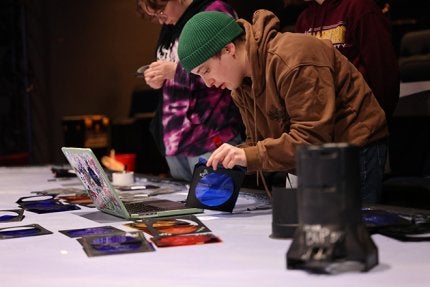
The fun, however, is not found simply in turning lights on and off. Lighting design begins with understanding the script and the world it creates, Lemons says.
“I love a good mood board,” Lemons says.
From there, the process becomes increasingly detailed. Lemons meets with the director to understand the desired direction, then creates paperwork outlining what each cue should accomplish. Spreadsheets and technical documents help translate the artistic vision into a workable plan.
“Once I know what I want the lights to do, I can figure out how to get there,” Lemons explains.
That work includes deciding where instruments should be placed, what colors and textures should be used, and how the lighting should guide the audience’s attention. Some lights may create a soft, diffused effect. Others may have sharp edges or project patterns called gobos.
Color can establish mood, suggest a change in time or place, or help communicate the emotional stakes of a scene.
“Your first concern is visibility, or lack thereof, whenever the director needs it,” Lemons says. “If you need people to be in the dark here and people to be lit up over here, you worry about that first.”
Only after those essential decisions are made can the broader artistic work begin.
“You can start thinking about things like the way you’re defining the actors on stage, the set pieces on stage,” Lemons says. “Color theory is such a big part of it.”
The Husky Difference
One of the biggest advantages of Bloomsburg’s theatre program, Theo says, is the opportunity to participate in the work from multiple angles.
The program’s close-knit environment allows students to take on responsibilities that might be reserved for more advanced students at a larger institution. Lemons has worked as an assistant to the technical director, learning about production administration, the scene shop and the behind-the-scenes organization required to bring a show to life.
Lemons also served as assistant lighting designer for These Women of Troy while taking a lighting design course. That combination of classroom learning and production experience offered an immediate opportunity to apply new knowledge.
“I got to learn a lot more about the design process and how that works,” Lemons says. “What the work calls are like for lighting load-in and focus.”
Lemons also designed lighting for a piece in the Bloomsburg’s Dance Minor concert. Though the piece was relatively short and straightforward, it represented an important milestone.
The first time Theo designed independently.
“It was a really good, I guess,” Lemons says.
Each experience helped prepare Theo for Ride the Cyclone, the first full production for which Lemons served as lighting designer. The project required months of preparation, followed by several days of hanging lights and additional hours of focusing.
Because the Alvina Cross Theatre is shared with the Bloomsburg Theatre Ensemble, students work in a professional space and benefit from access to a broad inventory of lighting equipment. Bloomsburg and the professional company maintain a mutually supportive relationship, allowing students to work with resources and professionals connected to the field.
The production process is demanding, also deeply collaborative.
“You can’t do it alone,” Lemons says. “In some ways it’s stressful, of course, but it’s also what I love about it.”
Lemons points to the support of technical professionals, faculty members and student crews as a critical part of the experience. The work may begin with one person’s concept, but it becomes reality through the combined effort of many people.
“I’m sure I would be much worse off if I didn’t have Ethan (Krupp) or Dave (master electrician for the Bloomsburg Theatre Ensemble), or the student crews we have,” Lemons says.
From classroom to recognition
When Ride the Cyclone opened, Lemons was still making adjustments. Notes continued through the final dress rehearsal, and even after the first performance, Lemons returned to make changes.
“I was so stressed,” Lemons recalls. “I had to go back and fix a couple things. I just care a lot about it, and I want to put out the best work that I can.”
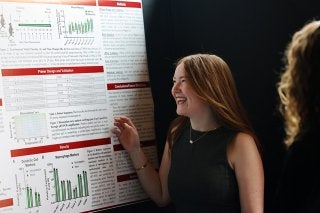
That commitment soon received recognition beyond the Bloomsburg stage. At the regional American College Theatre Festival, Lemons had the opportunity to present the Ride the Cyclone lighting design and connect with students, faculty members and theatre professionals from across the region.
The festival provided a broad view of the theatre community, featuring opportunities in performance, directing, dramaturgy, playwriting, stage management, scenery, costumes, sound and lighting.
“You get to connect with so many people,” Lemons says. “Being able to just look at all these really, really brilliant student designers who are also passionate about what they do was super valuable. Being able to get feedback from different faculty and lighting design professionals was really cool.”
Lemons was named a national finalist for lighting design, an achievement that led to an opportunity to attend the United States Institute for Theatre Technology conference in San Diego. The national event allowed Lemons to explore new equipment, attend a design expo and learn from professionals working at the highest levels of the field.
“I was so excited to see all the brand-new toys for lighting,” Lemons says. “… super excited to see what’s new, what’s hot, what’s possible.”
For Lemons, the recognition is meaningful not only because it validates the work but because it reflects the opportunities available at Bloomsburg.
“If you’re truly interested in developing yourself as an artist and as a theatre practitioner, there are those opportunities,” Lemons says. “And there are people (at Bloomsburg) who really want to help you succeed in those opportunities, which I think is so valuable.”