John Wetzel: ‘Who is Dr. King? He is You.’
Bloomsburg
Posted

“Dr. King was just like you.”
That was John Wetzel’s message to students, faculty, and staff who attended CU-Bloomsburg’s Dr. Martin Luther King Jr. Observance on Tuesday afternoon, Feb. 10.

Interim President Jeff Osgood introduced Wetzel, a case study of blending “rigor and humanity.” The chair of Commonwealth’s Council of Trustees and a 1998 Bloomsburg graduate, Wetzel was Pennsylvania’s Secretary of the Department of Corrections for nearly 11 years before launching his nonprofit, the Keystone Justice Center.
“The system is not about preserving the status quo. It is about questioning it, something you should do every day,” said Osgood. “It is about reimagining it, something you should participate in every day. And it is about building something better in its place. Institutions do not change simply because we hope they will. They change because people are willing to challenge them, strengthen them... and hold them to their highest purpose.”
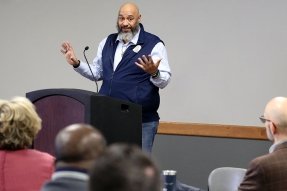
“This place means everything to me... I wouldn’t be standing here without Bloomsburg,” Wetzel told the group. “The most important thing is that Dr. King was just like you. That’s what you have to hear. Make it personal for you ... he was just like you. And frankly, at a time very similar to now.”
Wetzel pushed back against the perception that progress has been stagnant. “The notion that we didn’t make progress as a people — you gotta stop that. I would suggest that in our time now, we have some really serious questions we have to answer about civility in general, and how we’re going to interact with others, and how your generation is going to deliver democracy.”
To illustrate the danger of apathy, Wetzel revisited the story of Rip Van Winkle, a tale Dr. King himself used in his final speeches. Wetzel noted that people often focus on the man sleeping for 20 years, but they miss the most critical detail: the portrait at the inn.
“When he falls asleep, it’s a picture of the king. And when he wakes up, it’s a picture of President Washington,” Wetzel explained. “So Dr. King said Van Winkle had slept through the revolution. Are you paying attention to what’s going on? Progress doesn’t roll on the wheels of inevitability. Rather, it is brought about by disciplined nonconformists who are willing to be co-workers with God.”
You literally have the world as your oyster. Do not spend a bunch of time looking at barriers. Figure out how you’re going to impact the world. Focus on that.
Wetzel leaned into the concept of the “disciplined nonconformist,” a role he adopted throughout his career. “The reality of being somebody like him is that you’re not going to be popular.”
Wetzel spoke candidly about his upbringing and struggles as a student. “I was born in Danville, and I was immediately put in a foster care system. I’m an orphan who was adopted by a Pennsylvania Dutch family, and I grew up in Myerstown, Pennsylvania — the only Black guy,” he shared. When he arrived at Bloomsburg as a football player, he found a community that changed him. “I think there were about a hundred black people here. It was the darkest space I've ever been. I was so happy to be here.”
As Secretary of Corrections, Wetzel oversaw a massive system, but a trip to Europe fundamentally altered his perspective on what “justice” could look like. In Germany, he witnessed a “principle of normalcy” that upended his sensibilities. “They were completely focused on people’s humanity. They showed no punitiveness at all. I never saw anything like it.”
A visit to a prison in The Hague, where prisoners of the Nazi occupation had etched calendars into the walls with their fingernails, deepened the lesson. “Just treating people like humans shouldn’t be a high bar,” he said. “If Dr. King was here, he probably would have been saying the same thing: Why don’t we just treat them like humans?”
Wetzel concluded by urging the students to recognize their own power and worth. “There will be a seventeen percent reduction in school-age kids over the next 15 years. That means every one of you is a commodity. You literally have the world as your oyster. Do not spend a bunch of time looking at barriers. Figure out how you’re going to impact the world. Focus on that.”
“I’m a public servant. It’s the only thing that makes sense to me—helping others. But government just became a place where we couldn’t talk to each other,” said Wetzel. “For there to be a normal world, the world you guys have to create, we have to be able to get in a room and talk to people who disagree with us. Find the overlap. Break down these barriers.”