Advancing AI-Driven Cybersecurity: Collaborative AI Agents for IoT/IIoT Research at CU–Bloomsburg
Bloomsburg
Posted
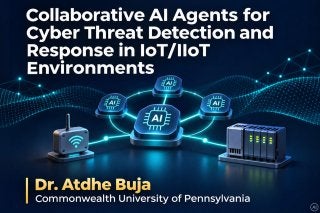
Commonwealth University–Bloomsburg is expanding applied cybersecurity and artificial intelligence research through a new project exploring how collaborative AI agents can improve cyber threat detection and response in Internet of Things (IoT) and Industrial Internet of Things (IIoT) environments.
Dr. Atdhe Buja, a professor in the Digital Forensics and Cybersecurity program within the Department of Mathematics, Computer Science, and Digital Forensics, received an $8,000 Commonwealth University Research and Scholarship Startup Grant for the project, “Collaborative AI Agents for Cyber Threat Detection and Response in IoT/IIoT Environments.” The project combines artificial intelligence, cybersecurity, IoT/IIoT technologies, and undergraduate research. It will also provide paid research opportunities for two undergraduate students who will work alongside Buja in developing, testing, and evaluating the research environment.
Collaborative AI for Cybersecurity
As IoT and IIoT environments continue to connect sensors, controllers, gateways, edge systems, and software services, they also introduce new cybersecurity risks and generate increasing volumes of security data that analysts must interpret. The project will investigate whether a group of specialized AI agents working collaboratively can analyze cybersecurity evidence more effectively than either traditional rule-based approaches or a single general-purpose AI agent. The research framework will include specialized AI agents responsible for different cybersecurity functions, including asset and network analysis, threat detection, vulnerability and threat intelligence, risk assessment, and response recommendations. A coordinating agent will bring information from the specialized agents together and produce an integrated cybersecurity assessment.
Building a Virtual IoT/IIoT Research Environment
Rather than allowing AI to automatically make changes to real systems, the research will focus on analyzing evidence, assessing risk, and producing cybersecurity response recommendations that can be evaluated against known experimental results. The central research question is whether collaborative AI agents can improve detection accuracy, contextual understanding, risk prioritization, and cybersecurity response recommendations in IoT/IIoT environments. A GPU-enabled AI and cybersecurity research workstation will serve as the primary computing platform for the project. The system will support locally hosted AI models, collaborative AI-agent workflows, cybersecurity monitoring tools, virtual systems, and experimental data collection. Instead of requiring an expensive collection of physical industrial equipment, the research will create a software-defined IoT/IIoT cybersecurity testbed. The environment will simulate several types of connected systems, including an IoT sensor using MQTT communications, an industrial controller using Modbus/TCP, an IoT/IIoT gateway supporting web and remote-access services, and a Linux-based edge/data node. Open-source cybersecurity tools will be used to collect network traffic, alerts, system logs, authentication events, configuration activity, and other evidence generated during controlled experiments. This approach will allow the research environment to be repeatedly reset, modified, and tested, making it possible to reproduce cybersecurity scenarios under controlled conditions while keeping the experimental environment isolated from production university systems.
Undergraduate Students as Research Team Members
An important component of the project is undergraduate research participation. The grant will support two paid undergraduate research assistants, providing mentored research experience. The goal is for students to experience more than individual cybersecurity exercises. They will participate in the research lifecycle — from building the experimental environment and conducting experiments to analyzing results and contributing to the communication of research findings.
Future Growth
The startup project represents the first stage of a broader research direction combining artificial intelligence, cybersecurity, and connected systems. Through the combination of faculty research, undergraduate participation, AI-enabled cybersecurity experimentation, and reusable research infrastructure, the initiative is designed to strengthen opportunities for students while advancing Commonwealth University's research capabilities in emerging areas of cybersecurity and artificial intelligence.
Learn more about CU's Digital Forensics and Cybersecurity program and the Center for Digital Forensics and Cybersecurity.