India Study Abroad: A Global Perspective on Education
Lock Haven
Posted
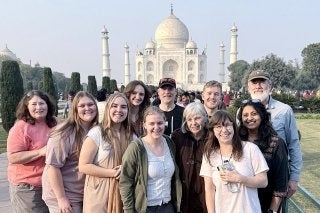
A group of Commonwealth University students had a window into how schools work, and children learn on the other side of the world over winter break.
Dr. Priya M. Poehner, interim associate dean and professor in the College of Arts, Humanities, Education, and Social Sciences, took a group of ten students on an 11-day tour of India during the break as part of her course “Teaching in Diverse Contexts,” which is also serves as a general education course for diversity.
“There were students who participated as part of the course who were not necessarily teacher education majors,” says Poehner. “It was a unique group who went with me.”
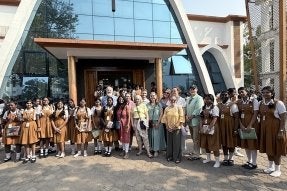
“I have been talking a lot about the diversity of public-school classrooms here in the U.S., and I thought this would be a good opportunity to have a chance to visit a culture that is completely different and compare their education system to ours,” Poehner continues. “I was especially interested in comparisons between the American education system and the Indian education system through a diversity lens.”
The group landed in New Delhi and from there visited diverse regions of India, spending time in Agra, Kochi, Mahabalipuram, and Chennai.
“One of the things we saw is that there are centralized standards that guide the curriculum in a very similar manner to what we do here in the U.S.,” says Poehner. “But the pedagogy of how information is shared with students is very different. Indian classrooms often have larger class sizes, with more teacher-focused rather than student-focused instruction. So, we observed more lecture-style instruction, more rote learning, and more call-and-response. We were very impressed at the active learning students demonstrated during these observations. It’s a different kind of engagement than what we see in our typical U.S. classrooms.”
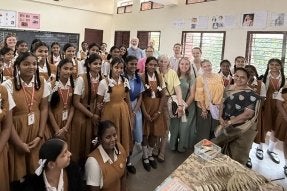
In addition to seeing Indian classrooms, the Commonwealth students got a glimpse of Indian life. “When you take a cultural tour, guides usually keep you away from the places that might be less appealing,” says Poehner. “We were right in the middle of it all. I wanted students to feel, to live the diversity, see the poverty, and understand the range of socioeconomic status and its impact on the cultural system.”
“The trip challenged how I see the world, how I understand hardship, and how I measure gratitude in my own life. There were moments that were deeply sad and heavy, as I witnessed firsthand how poverty shapes the way people live and how they view their circumstances,” wrote student Madelynn Killinger of her experience. “Yet the experience was incredibly empowering. The people we encountered welcomed us with open hearts, warmth, and kindness. Their hospitality and generosity, despite having so little, left a lasting imprint on me and reminded me of the power of human resilience.”
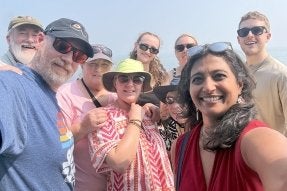
“This trip changed the way I look at my own life. Seeing how many people live on the streets and how crowded many areas were really opened my eyes,” reflected student Katherine Offenback. “It made me realize how much I take for granted every day, such as having a safe place to live, access to food, and other basic needs. Watching how people continue their daily lives despite these challenges helped me gain a new sense of appreciation and gratitude. I learned not only about India’s culture and history, but also about myself.”
While Killinger was struck by economic hardships, she found that Indian students were free from some worries that affect U.S. students. “During a panel discussion with a current Indian college student, I asked whether there was ever concern about gun violence or school shootings. The response I received stunned me. The student simply said, ‘No. We’re more concerned about getting kids to just come to school.’ That moment has stayed with me. It was a powerful and heartbreaking reminder of the vastly different realities students face across the world, and it forced me to reflect on the priorities, fears, and privileges within the U.S. education system.”
The students also visited global landmarks.
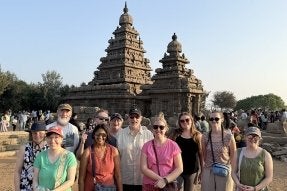
“I was in awe of the historic architecture of the Agra Fort and Taj Mahal, and being able to witness the fascinating stories embedded in their walls. I enjoyed experiencing some of the daily activities of Indian society,” wrote student Jordan Stahlman of his experience. “We visited stunningly beautiful and grand churches, temples, and synagogues, giving us a closer look at the religious practices of much of the global population. Visiting Indian schools helped reinforce my desire to become a global educator and help students not just in Pennsylvania but around the world. For some people, visiting India was a chance to travel the world and experience a foreign culture. For me, it was one of the first steps in becoming the global educator and citizen that I dream of becoming.”
For Poehner, the trip was also a homecoming. “One school that we visited was actually my alma mater in Chennai, where I went to school from seventh through twelfth grade,” says Poehner. “It’s neat to see the school and how little has really changed in these 31 years. And to relive some of those memories—it was a wonderful walk down memory lane as we participated in an assembly that used similar formats, music, and space from when I was a kid. Sharing this experience and setting with my CU students was a special experience.”
Faculty interested in leading a short-term program should contact Rosana Campbell (rcampbel@commonwealthu.edu) in the Center for Global Engagement for more information.
Additional Student Reflections
From the chaos of Delhi to the majesty of Agra and the Taj Mahal, on to the seaside towns of Kochi and finally Chennai, we experienced and thrived in the exciting maelstrom of daily Indian life. We saw temples, schools, markets and ruins, all while carefully and intentionally guided by Dr. Poehner. Her incredible passion for the subject matter and her tireless focus and dedication to all her students were obvious from start to finish.
— Ron Timko
What made this experience unique for me: traveling with others always means you see the world with your filters, but your companions make you see (sound, scent, taste, touch) other things as well. When I travel with people of my generation, we share a lot of the same filters. A trip with college students, for many of whom this is their first big adventure outside the U.S., vastly increases the opportunity to see the world around me in a different way. Each traveler did this for me: the educators, the education students, the exercise science student looking for adventure (and getting it in spades), the anthropologist looking for connections for her thesis (and finding them).
— Bill Byron (non-traditional student participant)
I am so incredibly grateful for this once-in-a-lifetime adventure. The laughter and memories we all shared, the countless meals spent trying each other’s foods, all of it made for such a precious and irreplaceable experience. I am most thankful to Professor Poehner. Without her drive, her compassion, and her kind heart that wanted to share her homeland with what was once a group of mostly strangers, then none of this would have happened. This was much more than just tourism and sightseeing; it was very lightly dipping our toes in all of India and what this vibrant country has to offer. I will never forget this trip.
— Teresa Celona
Learning about a new culture and exploring that culture for two weeks has helped me shape a global perspective that I will take into all aspects of my life, not just travel. I also think that stepping outside of my comfort zone gave me greater confidence, and if an opportunity like this presented itself again, I would take it without any apprehension. Journaling helped with this because I was able to write down what I saw, and it helped me process the events from days when we did so many different activities.
— Kira Good
“What makes someone family?” I wrote in my journal at 2 a.m. It was our last day in India, and we were scheduled to fly home in an hour. Family means that you share the same blood. Then why did I cry when I waved goodbye to an Indian man who lives halfway across the world? Why did I feel like I was sitting next to my family at the airport at 2 a.m.? I realized at that moment that family is more than shared relatives. Family are the people who understand and accept you. The people who experience the world with you. People who distract you as your plane takes off. People who give you a new hair-do. People who stay up late laughing with you. I realize now that I am incredibly blessed to have been a part of something so beautiful. I will remember the lessons this trip has taught me, and I reminisce on the memories this trip has gifted me.
— David Cooper